Compliant mechanism design A compliant mechanism attempts to achieve force and movement goals by exploiting flexible materials and the design shape (topology).
Examples include
paper clips
plastic hinges and plastic tops
Bows and arrows
clothes-pegs
Nuts and bolts
Prosthetic running blades
Advantages/disadvantages
Fewer parts, possibly a single material, easier to make
Can be designed to spring back to a neutral position
Suitable for bi-stable mechanisms
New design methods can be used such as generative design
Limited range of movements, continuous rotation not possible
Difficult to identify centres of rotation or predict movements and failures (at the moment).
An online lecture series by Jonathan Hopkins is available on you tube. This was covered in a 2022 journal club series with notes and links available on (http://www.cybernetia.co.uk/other/journalclub/compliantmechanisms.html )
Videos
VIDEO Veritasium: Why Machines That Bend Are Better
(Elephant in the room at 3:55)
VIDEO A computational design tool
See also [megaro2017computational ]
Flexures/blades
Thinning of the material to improve flexible characteristics
A wire flexure constrains 1 degree of freedom (D.o.F.), a blade flexure constrains 2 D.o.F
Beware of stress concentration at sharp internal corners, leading to crack propagation and failure. Fillets (available in Fusion360) allow a smooth transition.
Euler beam stiffness (linear) gives a blade flexure stiffness $K$ as $K=\frac{Ebh^3}{4L^3}$ where $b$ is beam width, $L$ is beam length, $h$ is beam height and $E$ is a material property called Young's modulus.
Materials for compliant mechanisms
Compliant mechanisms require material that have a
Large yield strength $\sigma_f$
Low Young's modulus
Low friction losses/repeatable movements
The Stratasyst F170 polyjet printer in the Poly Vacher building uses primary ASA although other materials are possible such as ABS or TPU.
ASA acrylonitrile styrene acrylate Materials data sheet <->https://3dprinting.co.uk/wp-content/uploads/2016/09/ASA.pdf Modulus E (Elastic) GPa 2.14 (0.07) Strength $\sigma_f$ (breaking point) MPa 30 (1)
--ooo--
TPU92A Thermoplastic polyurethane (elastomer) Materials data sheet <->https://3dprinting.co.uk/wp-content/uploads/2020/07/TPU-92A.pdf Modulus E (Elastic) MPa 15.3 Strength $\sigma_f$ (breaking point) MPa 15.6
The FlashForge printer uses primarily PLA
PLA Polylactic Acid Materials data sheet <->https://3dprinting.co.uk/wp-content/uploads/2020/07/PLA.pdf Modulus E (Elastic) GPa 3.039 Strength $\sigma_f$ (breaking point) MPa 46
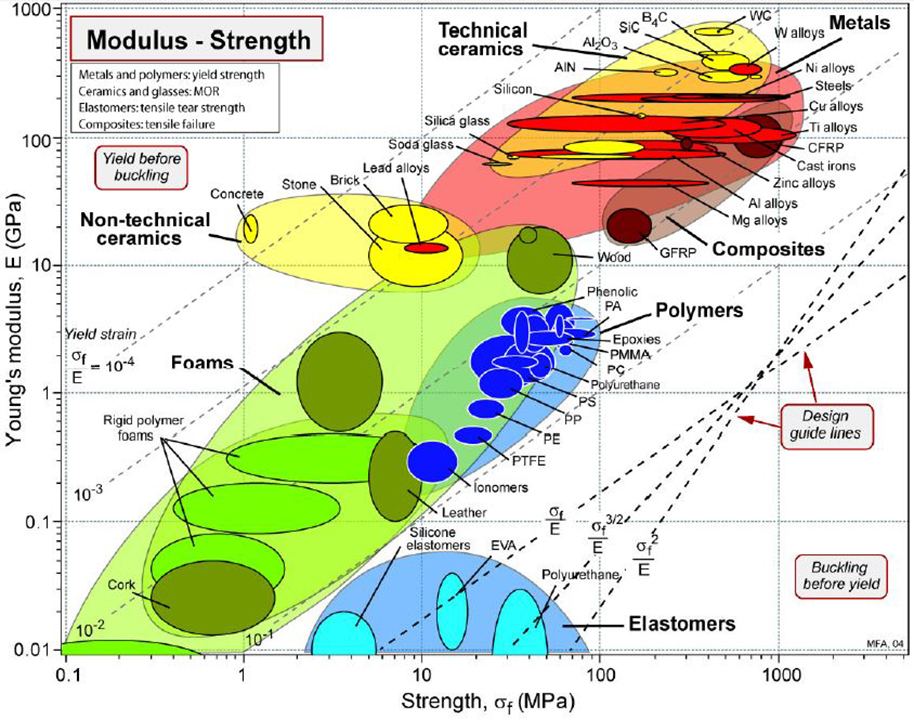
Ashby charts
Ashby chart for Young's Modulus (E) vs Yield strength $\sigma_f$ (CFRP=Carbon fibre reinforced polymer, PMMA=polymethyl methacrylate, PE=Polyethylene, PP=Polypropylene, PS=Polystyrene, PA=Polyamides (nylons), PC=Polycarbonate)
Other compliant mechanisms information
Lecture 31 Flexible Material and Mechanism Design : Bernhard Thomaszewski SCF 2019
Bergou Wardetzky Robinson Audoly Grinspun. Discrete elastic rods siggraph 08
19:50 Danit Peleg (fabric like materials) 20:09 Ref to Schumacher, Marschner, Gross, Thomaszewiski, Structured sheet materials siggraph 18 24:00 Discrete elastic rods Bergou 08/10 26:32 www.structuredsheets.com
VIDEO
U. Twente Flexure joints for large range of motion by Precision Engineering lab at the University of Twente
VIDEO
Disney
VIDEO
Other
VIDEO VIDEO
VIDEO UCLA
[megaro2017computational] Vittorio Megaro, Jonas Zehnder, Moritz B{\"a}cher, Stelian Coros, Markus H Gross and Bernhard Thomaszewski, "A computational design tool for compliant mechanisms.", 2017 ACM Trans. Graph. https://www.youtube.com/watch?v=FW6Vx2g9OCI